

Automotive Audio Is Accelerating. Are Measurements Keeping Pace?
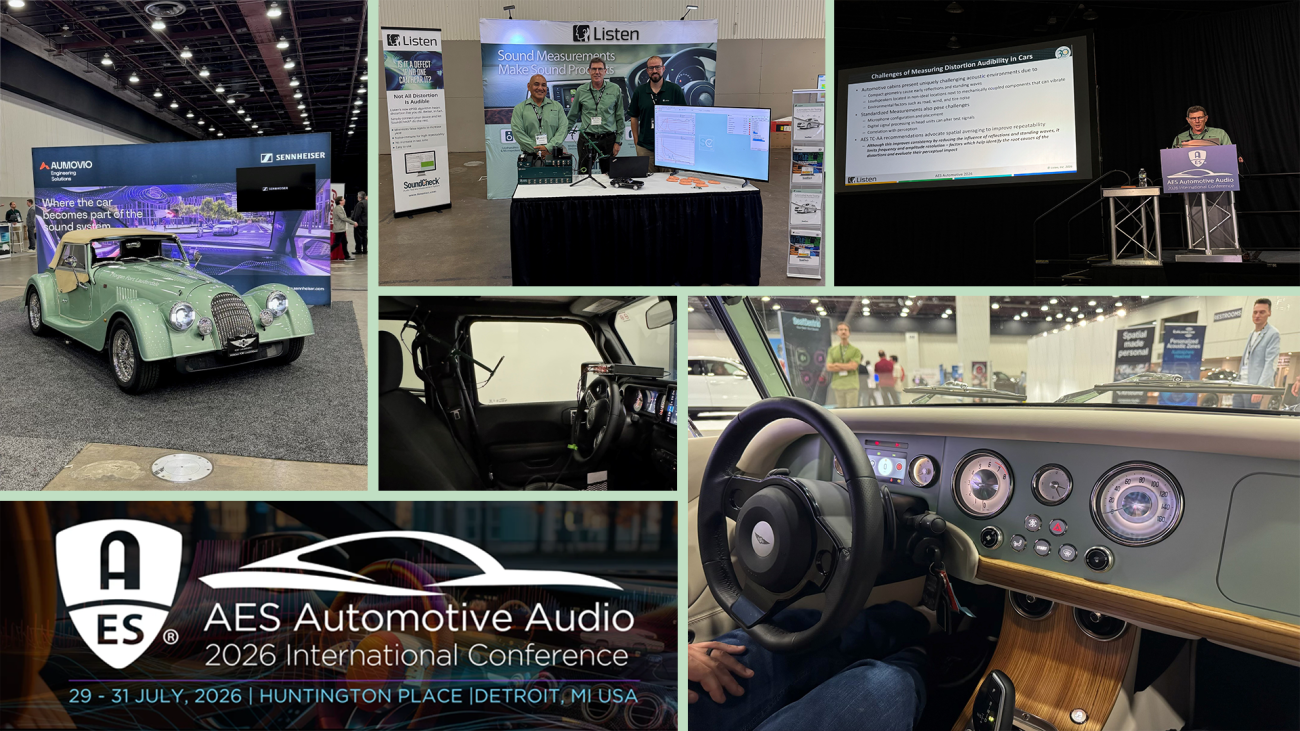
I’ve just returned from the AES Automotive Audio Conference in Detroit – an event I always look forward to because it combines two of my favorite passions: cars and audio. With an interesting mix of attendees from automotive OEMs, Tier 1 suppliers, loudspeaker manufacturers,
researchers and measurement engineers, it’s a great place to see the latest research and understand where the industry is heading.
As always, the content covered many areas, and after three days of presentations, demonstrations and conversations, I found myself reflecting on just how quickly automotive audio is changing – and how our evaluation methods are struggling to keep pace.
Looking back over the conference, what struck me wasn’t any single technology, but why so much innovation is happening in automotive audio. Electric vehicles have given us something that’s surprisingly rare in consumer audio: a quiet, highly controllable listening environment. Unlike the home, where room acoustics, loudspeaker placement and even the listener’s position are largely unknown, the interior of a vehicle is a carefully engineered space. Every loudspeaker location, reflective surface and listener position is known in advance. In many ways, it’s the ideal environment in which to create a consistent listening experience.
Perhaps that’s why we’re seeing so much innovation. Ten years ago, many of this year’s hot topics – headrest speakers, haptics, immersive audio and personalized sound zones – were little more than research projects. Today they’re finding their way into production vehicles.
One area where is particularly apparent is the growing use of headrest loudspeakers. Just a few years ago they were practically unheard of; today they’re being used for a wide range of applications, from enhancing immersive audio to creating personal sound zones, and also for active noise control.
At the conference, I saw much enthusiasm for the potential these provide, and it is clear that they are here to stay, but there is much less agreement on how they should be measured. Traditional automotive loudspeaker measurements were
 developed for speakers mounted in doors and dashboards, not a few inches from the listener’s ears. Questions about microphone placement, averaging techniques and the interaction with the rest of the vehicle audio system are still very much open for debate. Some have proposed measurement methodologies, but I didn’t see any that were practical, especially for high volume measurement. Furthermore, most manufacturers that I spoke to did not yet have a fully-developed test plan for these products. Until we reach some consensus, comparing measurements between different systems and manufacturers will be difficult – it’s definitely something we need to work on!
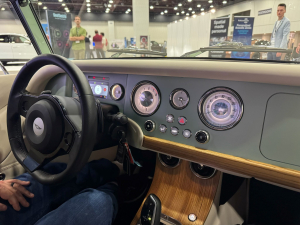
Another trend gathering momentum is haptics. Seat-mounted tactile actuators are becoming increasingly common as a way of enhancing low-frequency reproduction, but one demonstration in particular showed just how far this idea can be taken. Aumovio and Sennheiser demonstrated a Morgan sports car in which not only the seats, but the dashboard itself, became part of the sound reproduction system. I have to admit I was a little skeptical before hearing it, but I came away impressed – the sound quality was far better than I expected from a vibrating dashboard!
This makes me wonder how we’ll evaluate these increasingly complex systems where sound is felt as well as heard. I suspect this will also be a topic of much discussion in the next couple of years.
Another topic that generated a surprising amount of conversation was the sound of electric vehicles. Many manufacturers appear keen to retain an acoustic identity as they transition from gasoline engines to electric vehicles. This has usually involved recreating the signature sound of their internal combustion engine, but there now seems to be growing interest in amplifying or enhancing the natural sounds produced by the electric drivetrain itself to create a new sound signature. I understand the motivation, although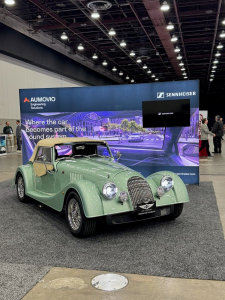 personally, one of the things I enjoy most about driving an EV is the absence of engine noise. I’d rather the engineers spent their effort making the cabin quieter and the music sound even better!
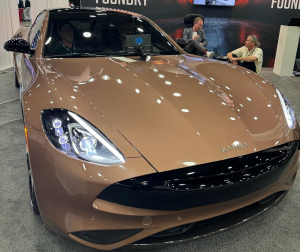
Of course, as automotive audio systems become more sophisticated, they’re also becoming more complex. Premium vehicles containing more than 30 loudspeakers and exciters no longer seem unusual – I think one car on display at the conference event had a total of 46! From the customer’s perspective the audio possibilities this presents are exciting. From a manufacturing perspective it presents an entirely different challenge. Every additional transducer, mounting point and trim component represents another opportunity for buzz, squeak, and rattle distortion or assembly defects. This inevitably brings us to a subject very dear to me – distortion.
Despite all the innovation taking place in automotive audio, I was interested to see how often Total Harmonic Distortion (THD) still continues to appear in presentations and product specifications. THD is a well established and often useful audio metric, but inside a vehicle it’s often a
 poor predictor of what listeners actually hear. Reflections, multiple sound sources and the acoustic complexity of the cabin make it difficult to relate a conventional THD measurement to perceived sound quality.
That was the subject of the paper I presented at the conference. Rather than relying on traditional THD measurements, I discussed the use of Frequency Normalized Distortion together with perceptual and time-domain distortion metrics that show much better correlation with audible defects while still being practical for production-line testing. I’m not suggesting that we’ve completely solved the problem, but I do think it’s time to move beyond measurements simply because they’re familiar, and take a hard look at what measurements actually reflect what people actually hear.
One thing sadly missing this year was a meeting of the AES Technical Committee on Automotive Audio. That said, it was encouraging to see how widely the committee’s work has already been adopted. The recommended six-microphone array appeared in presentation after presentation, which suggests the industry is converging on a common measurement methodology. The next challenge is making that methodology accessible. Not every engineering team has the budget for a dedicated measurement array, particularly when multiple systems are needed across R&D and production. We used the conference to introduce a new low-cost six-microphone array. By using a 3D-printed design that accepts any standard ¼-inch microphone, we’ve significantly reduced the cost of TC-AA compliant measurements while adding practical features such as snap-in microphone mounts and an integrated bubble level to facilitate alignment. We hope this will remove one of the barriers to wider adoption of the TC-AA methodology.
The irony is that while the listening environment has become more controllable, the measurement problem has become considerably more complex. Consumer loudspeakers are still largely evaluated in anechoic or simulated anechoic conditions because we have no idea where they’ll eventually be used. In a vehicle we know exactly where everything is, but we now have multiple loudspeakers operating simultaneously, strong reflections, listeners sitting close to transducers, structural vibration, and entirely new ways of delivering the listener experience, such as haptics. Developing measurements that are meaningful, repeatable and comparable across different vehicles is one of the biggest challenges facing automotive audio. Reaching consensus on those measurements may prove just as difficult, but the discussions taking place at conferences like AES Automotive are an important step in the right direction.


