Registration required

The content you have requested is available only to registered visitors. Please complete the short form below (all fields are required).

  • 简体中文 简体中文 Chinese (Simplified) zh-hans
  • English English English en
Listen, Inc.
  • Products
    • AUDIO MEASUREMENT
    • System Overview
      • What Soundcheck Measures
      • SoundCheck for R&D
      • SoundCheck for Production
      • Innovation
    • SoundCheck Software
      • Making Measurements
      • Algorithm Highlights
      • Integration
      • What’s New?
      • Packages, Modules & Pricing
      • Support Contracts
    • Audio Measurement Interfaces
      • AudioConnect 2 (2 channel))
      • AmpConnect 621 (6/2 channels)
      • AudioConnect 8×8 (8 channel)
      • AudioConnect 6×2 (6/2 channel)
      • AmpConnect ISC (2 channel)
      • 3rd Party Audio Interfaces
    • Audio Testing Hardware
      • Microphones & Amplifiers
        • Measurement Microphones
        • Microphone Power
        • Audio Test Amplifier
      • Specialist Test Interfaces
        • Bluetooth Audio Measurement Interfaces
        • MEMS microphone Interfaces
        • DC Connect
      • Audio Test Accessories
        • Turntables
        • Halo Automotive 6-Mic Array
        • Automotive Audio Test Kit
        • The SCC-1 Ear Coupler
        • Other Measurement Transducers
        • Impedance Box
        • Calibrators
    • NOISE & VIBRATION MEASUREMENT
    • System Overview
    • NoiseCheck Software
    • Noise & Vibration Interfaces
    • Noise and Vibration Testing Hardware
  • Applications
    • Headphones & Headsets
    • Loudspeakers & Microspeakers
    • Microphones
    • Automotive
    • Communications
    • Smart Devices
    • Hearing Aids
    • Audio Electronics
  • Support
    • Get Support
    • User Documentation
    • Knowledgebase
    • Training
    • Sequences & Resources
    • Drivers
    • Register Product
    • Report a Bug / Request a Feature
  • Resources
    • ‘Sound Matters’ Blog: Audio Measurement Expertise
    • Test Sequences
    • Article Reprints
    • Published Papers
    • Technical Notes
    • Measurement Services
    • Useful References
  • News & Events
    • News
    • Events
  • About Listen
    • Listen, Inc.
    • Contact
    • Distributors & Reps
    • Careers
    • Privacy Policy
  • Menu Menu

Stweep Turns 30: The Test Signal That Changed Audio Measurement
July 18, 2025/in Blog/by Julius Wijono

Everyone in audio test recognizes the ‘zip’ of the Stweep™, one of the world’s most ubiquitous audio test signals. But did you know it’s 30 years old this year? 

It was developed by Steve Temme and made its debut in the first commercially available version of SoundCheck, launched in 1995. Since then, it has been adopted on thousands of production lines and in development labs worldwide and is still the stimulus of choice for testing a wide range of electroacoustic products, ranging from simple speaker drivers to complex automotive infotainment systems.

But what exactly is a ‘Stweep’, how is it different from a stepped sine sweep, and why has it stood the test of time so well?

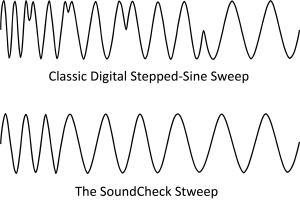
When you’re evaluating speakers, headphones, microphones, or other electroacoustic devices, the speed, accuracy, noise rejection and specific parameters that can be measured depend heavily on the stimulus signal used. Up until 1995, a standard stepped sine sweep was a popular choice for many electroacoustic tests as it produced results across a range of frequencies. This plays a sine wave at discrete frequencies, step by step, within a user-defined frequency range, and the user sets a resolution value to determine how many steps there will be.

Although extensively used, for example in the legendary Bruel and Kjaer 2012 analyzer, a stepped sine sweep has its limitations. It typically contains discontinuities because the frequencies do not change at a zero phase and amplitude crossing. This makes it slow as the device under test needs to settle at each new frequency. It is also inefficient at high frequencies where acoustic wavelengths are short, and potentially inadequate at low frequencies where settling times are long. The number of steps and their spacing are also critical. Too few steps can miss critical details; too many extend the test time unnecessarily.

In 1995 SoundCheck entered the market with the Stweep,  a new proprietary test stimulus. The Stweep is an optimized stepped sine sweep that generates an integer number of cycles at each frequency step. This ensures a smooth “zero crossing” transition from step to step. It is also phase-continuous from frequency step to frequency step, which makes it sound more like a sine chirp than a stepped sine sweep. This reduces transducer ringing and decreases settling time which yields faster and more accurate measurements. Settling time is further reduced by sweeping from high to low as low frequencies have more energy than high frequencies.

The Stweep is user-configurable with different resolutions and averaging times at high and low frequencies to optimize the trade-off between stimulus duration and resolution. This customization enables a much faster sweep, cutting test time to a fraction of what it would be using the previous stepped sine method. As well as speed and accuracy, the Stweep demonstrates good noise immunity and allows many test parameters to be measured in parallel including frequency response, phase, harmonics, intermodulation with two sine waves, perceptual distortion metrics, and impedance,with a single sine sweep.

Over the past 30 years, the Stweep has become synonymous with fast, reliable end-of-line testing. It remains unmatched in its ability to combine acoustic, electrical, and perceptual measurements in a single sweep—delivering the speed, precision, and noise immunity modern production demands. A smoother continuous transition and other refinements introduced in 2017 further optimized its performance for large frequency steps and equalized measurements. While others are only now beginning to adopt similar stimuli, Listen’s Stweep continues to lead as one of the most advanced and versatile signals in the audio test engineer’s toolkit.

Traditional Stepped Sine Sweep

https://www.listeninc.com/wp/media/2025/07/trad_stepped_sine.wav

Stweep

https://www.listeninc.com/wp/media/2025/07/stweep.wav


Share
  • Share on Facebook
  • Share on Twitter
  • Share on WhatsApp
  • Share on LinkedIn
  • Share by Mail
https://www.listeninc.com/wp/media/2025/07/Sweep-vs-Stweep.png 1572 2266 Julius Wijono https://www.listeninc.com/wp/media/logo.png Julius Wijono2025-07-18 10:22:572025-11-21 11:39:03Stweep Turns 30: The Test Signal That Changed Audio Measurement

Audio Measurement Expertise


How Changing Industry Needs are Shaping Audio Test and Measurement

Smarter SoundCheck Sequences with Loops and Logic

Audio Basics: Polarity

How to Measure: Haptics

The Value of Big Data

Audio Basics: Phase Response

view all

Latest News


2026 End Of Year Promotions

Celebrating 30 years: Listening – The Secret Of Our Success

Automotive Test Sequence Including BSR, Max SPL and Frequency Response

Listen Introduces AudioConnect 2, a New Portable Dual-Channel Audio Interface

SoundCheck 21 Brings Enhanced Loose Particle Detection, Multichannel FFT, Metadata, Sequence Protection and more


Audio Measurement Expertise – Delivered Monthly


ABOUT LISTEN INC

Listen is a global leader in audio measurement and analysis, with over 30 years’ experience developing innovative test methods and algorithms. SoundCheck, our powerful software-based audio analyzer, pairs with our test interfaces, precision microphones, and accessories to offer a complete solution for testing loudspeakers, headphones, microphones, smart devices, communication systems, hearing aids, automotive audio, and more. Trusted by engineers worldwide, Listen delivers the accuracy and flexibility essential for modern audio testing, from the R&D lab to the production line.

PRODUCTS
APPLICATIONS
SUPPORT
RESOURCES
NEWS & EVENTS
ABOUT

CONNECT

YouTube
LinkedIn
LinkedIn
Share
Instagram

Copyright © Listen, Inc.   |   Privacy Policy   |   AI Disclosure
  • Instagram
  • LinkedIn
  • Youtube
  • Mail
The NEW AudioConnect 8×8™ Audio InterfaceUsing Masking Curves for Measurement Insights
Scroll to top